
Andy Burnham has recently signalled his support for Bristol building a tram network. The problem is that we have been here before several times. Bristol’s trams have been approved by the government twice before – in 1989 and again in 2001 – but yet the home of Isambard Kingdom Brunel remains without a mass transit system.
If – and this is a catastrophically large if – everything currently being proposed gets built, Greater Bristol’s rail, tram, and metro network will look something like this in a few years time:
It almost goes without saying that really only the grey lines and a couple of the blue ones on that map currently exist. How we get there will be the culmination of two projects which are under different stages of development. These are the Bristol tram, and MetroWest.
Bristol Trams: A History
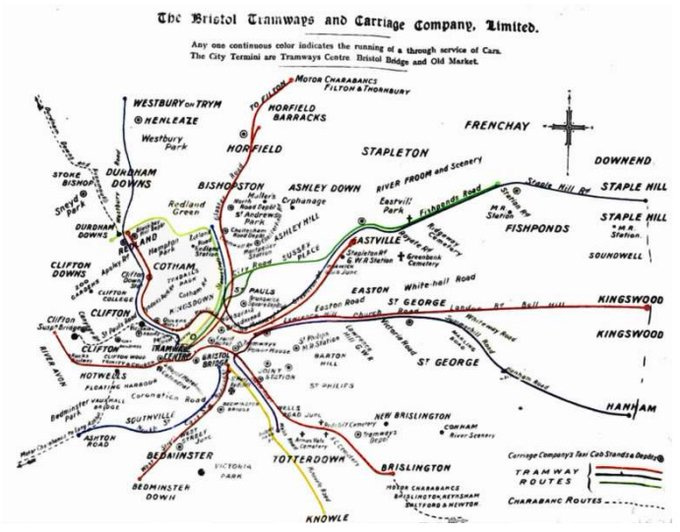
Like most British towns and cities, Bristol had an extensive Victorian tram network that was ripped up by short-sighted planners and councils after the war (actually in this case the power supply for the trams was bombed in 1941 and they never rebuilt them, but the decision was still made not to rebuild them), and now Bristol has some of the worst congestion in the country.
Advanced Transport for Avon
The idea of a metro system for Bristol reappeared in 1986 as Advanced Transport for Avon (ATA), which was going to be a light rail system utilising street-running in the city centre, and then running north to either Bradley Stoke or possibly out to Yate on a mixture of existing railway lines or alignments and street-running. The closed line to Portishead and the existing line to Severn Beach were to be integrated into the system at a later date.
The government wasn’t enormously in favour of building a tram “system” with a single line, and while Royal Assent was granted to converting the Portishead branch and to building the street-running city centre section in 1989, nothing really came of it. As with so many tram projects, ATA eventually got rebranded as an express bus service and then died in ignominy.
ATA may have been dead, but the desire for Bristol to have a tram was only just getting started. Unfortunately the route to getting there was scuppered somewhat by the abolition of Avon County Council in 1996. This is where local government shenanigans really started to mess things up for Bristol.
Westway and Bristol Supertram
Avon, despite its name, was always supposed to be Greater Bristol. Without Avon, Bristol was cut back to the pitifully small Bristol City Council area, which was last expanded in 1966 despite significant suburban growth. Those suburbs belong to neighbouring counties however, which historically have not liked working as Bristol’s extremities.
Bristol and South Gloucestershire councils managed to come to an agreement on a tram project called the Westway in the late 1990s. Westway was to be a street-running horseshoe around the city centre, then from Temple Meads along a newly four-tracked rail alignment and then street-running to a park and ride at Bradley Stoke or Almondsbury.
The city centre sections were deemed too expensive and the loop swiftly became a single line north from Temple Meads to Bradley Stoke, which was pretty much the ATA plan with the north-eastern leg chopped short.
Despite scaled back ambitions Westway was popular with voters, with several polls suggesting 80-90% support and bolstered by this the planned lines got a little longer. To advertise the project, a Parry People Mover was driven up and down an abandoned stretch of industrial railway on the harbourfront from 1998-2000. In 2001 Westway was renamed Bristol Supertram and granted approval and funding from the Department of Transport. The idea was, eventually, for four or five lines - however the initial proposal was the Westway line.

Unfortunately none of this happened, the City Council got spooked by having already paid £1.5 million, Gloucestershire pulled out, and a lot of uncertainty remained on the route and how much the whole thing would cost. In the end the tram was axed in 2004 and the money set aside was used to keep council tax lower for a year.
Bristol’s New Tram Proposals
Bristol focused on buses for some years. In 2017 the West of England Combined Authority (Avon County Council with new letterheads and less influence), started looking at different approaches for a Bristol tram or underground network. These unsurprisingly used the same existing rail alignments to reach the same locations as the earlier proposals. Various consultations took place and in 2022 a report was published with an outline for a four line system, all starting at Temple Meads and going roughly north to Aztec West, northeast to the Bristol and Bath Science Park, east to Keynsham, and south to Bristol Airport.
These new proposals have been costed for either light rail (i.e. trams), or underground. The chances of building an underground railway seem astronomically slim, so I am going to assume for now that it will be a tram network. The rough layout of the lines go back to plans drawn up by Avon County Council in the 1980s, but there is an important difference this time, and that is MetroWest.
MetroWest
MetroWest (once known as the Greater Bristol Metro) is an ongoing project between Great Western Railway, Network Rail, Transport for Greater Bristol, the West of England Combined Authority, and the various councils of Bristol, South Gloucestershire, Bath and North East Somerset, and North Somerset.
The plan for MetroWest is to reopen the lines from Portishead and Henbury into Temple Meads, and also improve service frequency as far out as Gloucester and Westbury. When complete, it will “[generate] over 2.7 million new rail journeys and [give] 100,000 more people access to train services.”
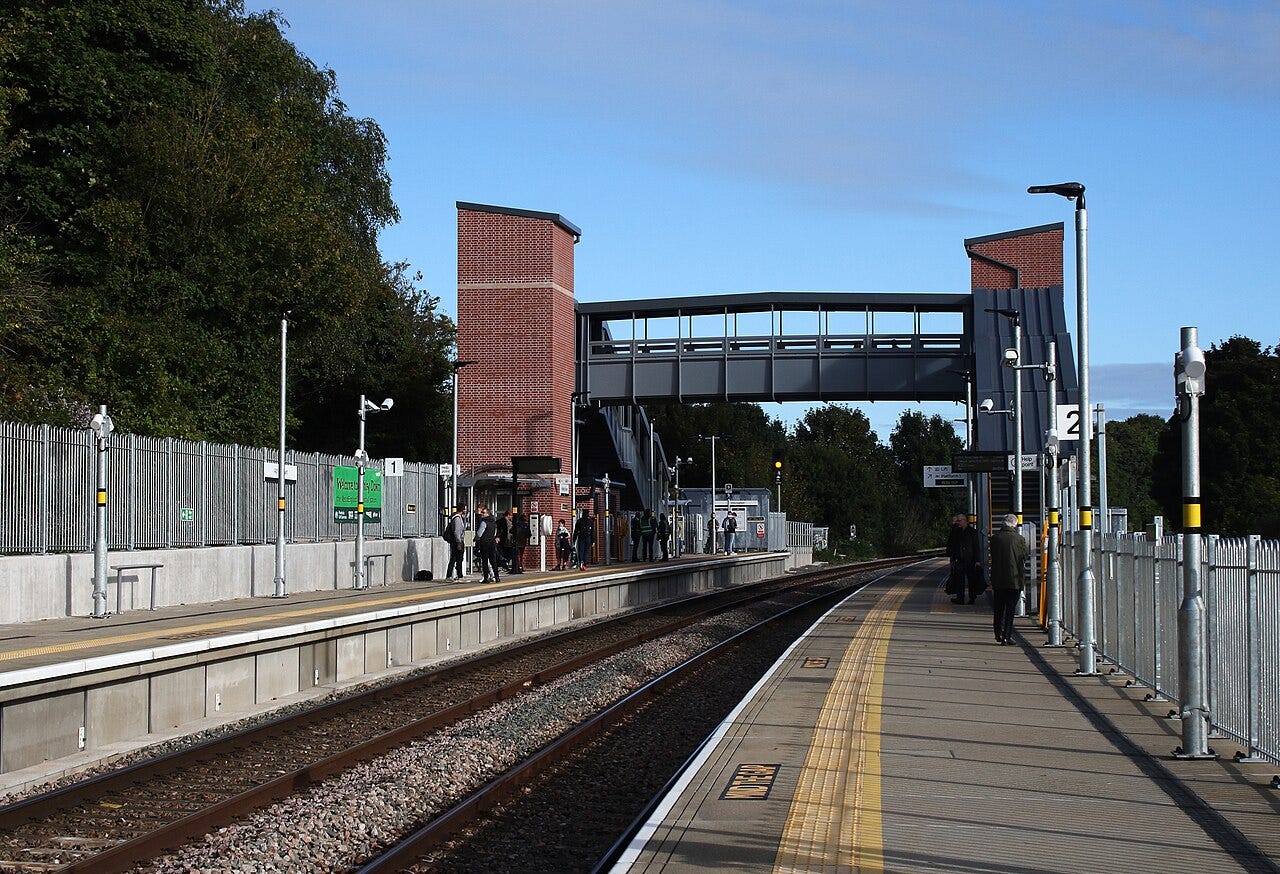
MetroWest is progressing surprisingly well for a British transport project, in that things are actually being built. Congested sections of the lines out of Temple Meads have been four-tracked, and new stations have either been built or are quite a long way through the planning process. The Portishead line is set to be open by 2028.
Having MetroWest alongside the tram proposals probably increases the chances of tram tracks being laid. The whole thing starts to look more like an integrated transport network for the region rather than an over-bold plan from Bristol City Council. And of course, Andy Burnham has said it would be a nice idea.
Will it happen?
Drawing lines on a map is much easier than building a metro system. I’ve been doing the former for years, but the closest I’ve ever got to locomotive transport was about half a model railway when I was ten. That said, I think there are some good signs for Bristol getting trams.
Firstly everybody seems to be behind the plans, in some way or another. The West of England Combined Authority has lessened council squabbling, and MetroWest is supported across the local authority board – financially as well. Linking the airport to the city has also been a long term goal. Bristol is the only regional airport in the country without a tram or train connection, and building that connection is a priority for the West of England Combined Authority. Finding the money for the trams will be the main issue, however the current plans are putting lines through key growth areas such as the Brabazon New Town and various science and innovation parks. With Bristol growing in population and economy at a decent rate, there should be an opportunity for serious land value uplift if the trams do get built, especially with the new NPPF making it easier to build around stations.
Hopefully at least the MetroWest will all be finished and some of the tram lines will be built as well, time will tell. This whole article was mostly an excuse to make a map anyway.
The best example for Bristol is Nottingham who despite the sniffy Notts County Council are now bidding for funding for a fourth line.
Bournemouth Airport would like a word about its lack of rail connections